
Unknown's avatar

About jbwoodward

John serves as Director of Counseling and Training for Grace Fellowship International. His main article archive is GraceNotebook.com

Summer 2026 Newsletter

There is a peculiar loneliness in loving someone whose behavior you cannot defend.

Love does not necessarily disappear when terrible truth comes to light.

A mother may be unable to comprehend that the baby boy she once rocked in her arms has taken another person’s life and now faces years—or perhaps the rest of his life—in prison. A wife may discover that her husband has secretly spent years paying for online sexual content, wiping out their savings and accumulating enormous credit card debt. A father may weep as he watches his daughter being placed in handcuffs and led from the courtroom, knowing that she will spend years behind bars. Children may spend years in foster care because addiction repeatedly took precedence over their safety and needs, and yet still long desperately for a relationship with the deeply flawed parents who failed them.

Human attachment is not simple. It does not always follow logic or rational thought.

  • It is complicated.
  • It is messy.
  • And sometimes it hurts beyond words.

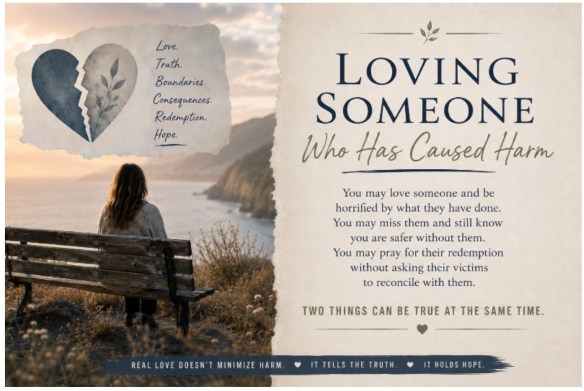
You may love someone and be horrified by what they have done. You may miss them and still know that you are safer without them. You may grieve their imprisonment while believing that incarceration is the appropriate consequence for their actions. You may remember their tenderness while also acknowledging their cruelty. You may pray for their redemption without asking their victims to reconcile with them.

Two things can be true at the same time.

Loving someone who has caused harm does not require minimizing the harm done to victims—or to you.

  • It does not mean interfering with justice.
  • It does not mean hiding crimes, protecting reputations, silencing victims, or making excuses.
  • It does not mean pretending that the harm was less serious than it actually was.
  • And it does not require defending what cannot be defended.

Sometimes love looks like …

  • telling the truth.
  • Sometimes love looks like allowing consequences.
  • Sometimes love looks like maintaining distance.
  • Sometimes love grieves from far away.

There is also an important difference between privacy and secrecy.

You do not owe everyone the details of your family’s most painful experiences. You are allowed to protect your privacy and choose carefully whom you trust with your story.

But secrecy that exists to protect wrongdoing, silence victims, shield someone from appropriate consequences, or preserve a false image is something very different.

You can refuse to participate in deception without making your private pain available for public consumption.

Perhaps one of the hardest truths to accept is that you do not have to stop loving someone in order to see them clearly.

And you do not have to defend them in order to love them.


– 
Excerpt from the new book Addiction and Abuse: Understanding the Intersection Between Addiction and Harmful Relationship Dynamics. Coming Fall of 2026. 


Your donations are greatly appreciated and are what allows the ministry to continue. If God lays it on your heart to help support Love Them To Life,  please use the following link: Donate here.

Blessings,

Cherri Raws Freeman

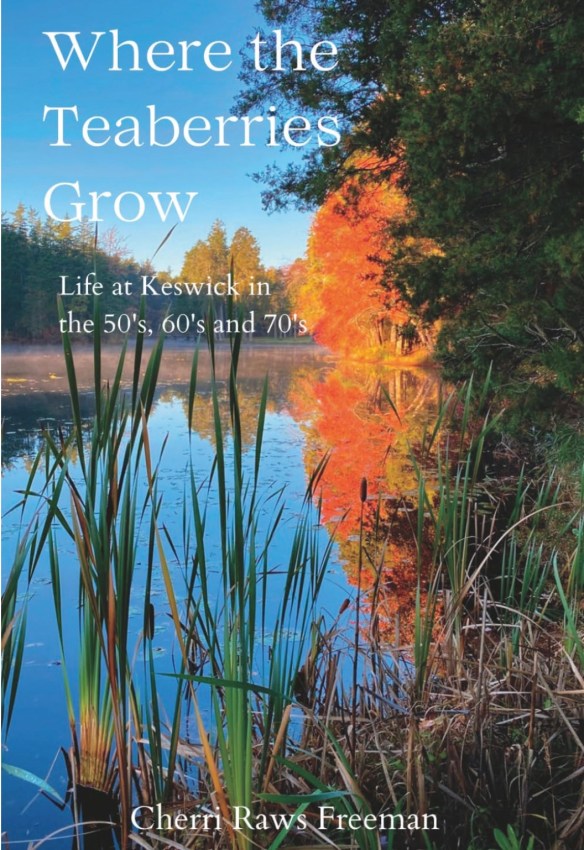
Growing Up At America’s Keswick: A Memoir by Cherri

Where the Teaberries Grow is a tender and richly remembered portrait of a childhood shaped by place, faith, and family legacy.

Set against the backdrop of America’s Keswick, this memoir invites readers into a world both ordinary and sacred—where lakes and footbridges, gathering halls and quiet corners became the setting for a life deeply formed by God’s presence.

Through vivid storytelling and carefully woven reflection, the author shares the “little history” of Keswick—the moments not recorded in official accounts, but lived day by day: childhood memories, family rhythms, seasons of joy, and the quiet shaping of identity and faith.
At the heart of this story is a legacy—one carried through generations, marked by devotion, sacrifice, and the steady call to follow Christ.

With warmth, honesty, and a deep sense of place, Where the Teaberries Grow is more than a memoir. It is an invitation to remember, to reflect, and to consider how the places and people in our lives quietly shape who we become.

Download free sample: Chapter 1

Order on Amazon.com here.

Spring 2026 Update

Love Them To Life often walks with families facing one of the most painful realities of loving someone in addiction: learning when love must say no.

Alex lives on the streets in one of the roughest areas of a major East Coast city. He receives disability income, and each month when his check arrives, the cycle begins again—he buys a phone or tablet, some food, and as many drugs as he can get. Within a week, the device has been stolen or pawned, the money is gone, and desperation sets in.

That is when the calls come. He wants a ride to the hospital or rehab because this time he is really done. He detoxes for a few days, leaves again, and returns to the streets with a new plan: get housing, start methadone, stabilize his life.

Meanwhile, his family lives under the shadow of dread, wondering if the next phone call will come from the police—or the morgue.

“I love you, but I can’t” is a phrase I often teach the women in the Love Them To Life community. When someone is trapped in addiction, the requests can feel endless:

• “Can I move back home just for a little while?”

• “I need money so a dealer doesn’t hurt me.”

• “I need money for rehab.”

• “I need help with rent.”

• “I just need food.”

• “This time will be different.”

Each request pulls at the heart.

Saying no can be one of the most heart-wrenching things we ever do. Sometimes the request sounds reasonable. Sometimes it comes with promises to pay you back. Sometimes it feels as though they may die on the streets if you do not step in. Add to that the guilt, pressure, and manipulation that often accompany addiction, and it can feel impossible to hold a boundary.

But as counterintuitive as it seems, saying no is often the most loving response.

Why?

1. Enabling prolongs destruction.
When we repeatedly remove consequences, we may unintentionally help sustain the addiction that is harming them.

2. Consequences can become turning points.
Many people do not seek real change until the pain of staying the same becomes greater than the pain of change.

3. Hope can keep us trapped.
We desperately want to believe this will be the time treatment works, the promises are real, and lasting change begins.

4. Boundaries are not abandonment.
Allowing someone to face reality may feel cruel in the moment, but rescuing them again and again can delay the very surrender that could save their life.

Sometimes the hardest no is the doorway to the first real yes.


Partner With Love Them To Life

Love Them To Life is supported entirely through the generosity of those who believe in this mission. I receive no salary, and every donation goes directly toward ministry expenses so we can continue offering hope, encouragement, and practical support to families impacted by addiction and brokenness.

If God lays it on your heart to partner in this work, I would be deeply grateful for your support. Thank you so much!

lovethemtolife.com/donate