

There is a peculiar loneliness in loving someone whose behavior you cannot defend.
Love does not necessarily disappear when terrible truth comes to light.
A mother may be unable to comprehend that the baby boy she once rocked in her arms has taken another person’s life and now faces years—or perhaps the rest of his life—in prison. A wife may discover that her husband has secretly spent years paying for online sexual content, wiping out their savings and accumulating enormous credit card debt. A father may weep as he watches his daughter being placed in handcuffs and led from the courtroom, knowing that she will spend years behind bars. Children may spend years in foster care because addiction repeatedly took precedence over their safety and needs, and yet still long desperately for a relationship with the deeply flawed parents who failed them.
Human attachment is not simple. It does not always follow logic or rational thought.
- It is complicated.
- It is messy.
- And sometimes it hurts beyond words.
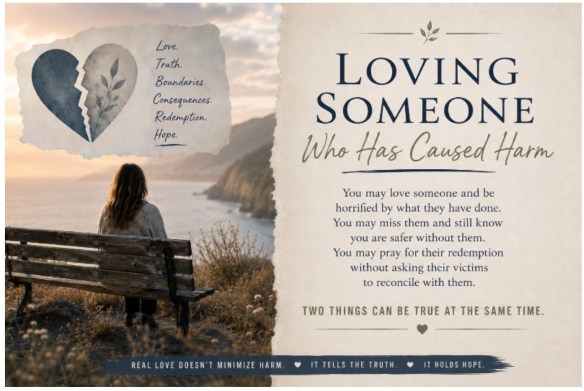
You may love someone and be horrified by what they have done. You may miss them and still know that you are safer without them. You may grieve their imprisonment while believing that incarceration is the appropriate consequence for their actions. You may remember their tenderness while also acknowledging their cruelty. You may pray for their redemption without asking their victims to reconcile with them.
Two things can be true at the same time.
Loving someone who has caused harm does not require minimizing the harm done to victims—or to you.
- It does not mean interfering with justice.
- It does not mean hiding crimes, protecting reputations, silencing victims, or making excuses.
- It does not mean pretending that the harm was less serious than it actually was.
- And it does not require defending what cannot be defended.
Sometimes love looks like …
- telling the truth.
- Sometimes love looks like allowing consequences.
- Sometimes love looks like maintaining distance.
- Sometimes love grieves from far away.
There is also an important difference between privacy and secrecy.
You do not owe everyone the details of your family’s most painful experiences. You are allowed to protect your privacy and choose carefully whom you trust with your story.
But secrecy that exists to protect wrongdoing, silence victims, shield someone from appropriate consequences, or preserve a false image is something very different.
You can refuse to participate in deception without making your private pain available for public consumption.
Perhaps one of the hardest truths to accept is that you do not have to stop loving someone in order to see them clearly.
And you do not have to defend them in order to love them.
– Excerpt from the new book Addiction and Abuse: Understanding the Intersection Between Addiction and Harmful Relationship Dynamics. Coming Fall of 2026.
Your donations are greatly appreciated and are what allows the ministry to continue. If God lays it on your heart to help support Love Them To Life, please use the following link: Donate here.
Cherri Raws Freeman

